
The Conductor Doesn't Play an Instrument - And That's the Point
I was in a leadership discussion recently when my client said something that stopped me mid-thought.
We had been talking about the discomfort of slower seasons, those stretches where the team is running well, the systems are holding, and there isn't a fire to put out. Intellectually, he knew everything was fine. Operationally, things were better than they'd ever been. But emotionally, he felt like he was disappearing.
"It's like," he said, searching for the right words, "I'm just reviewing things that other people are doing right. I'm not really adding anything."
And then, almost to himself: "I'm supposed to be the boss. So I should be doing more than everyone else."
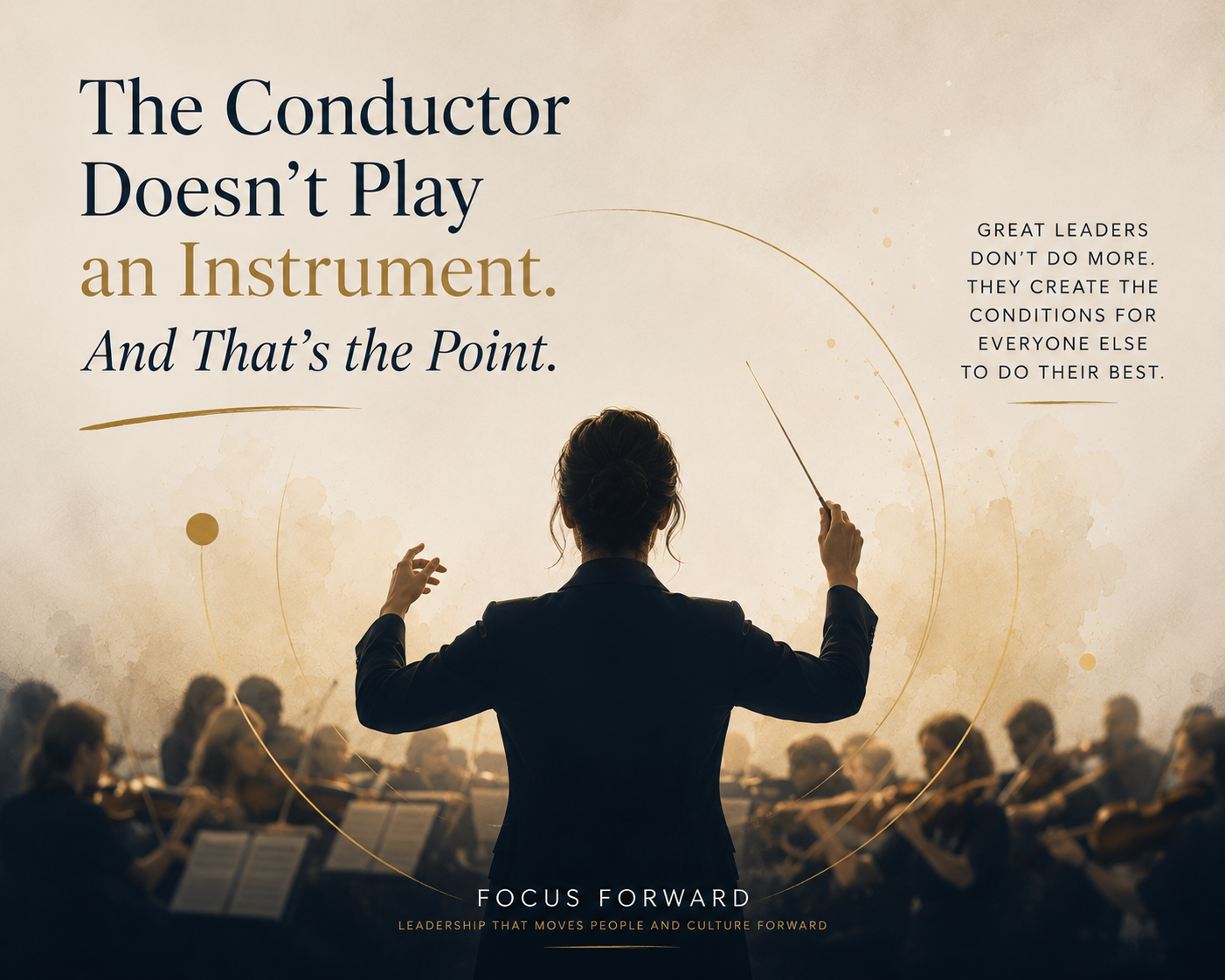
I sat with that for a second. Then I asked him: "What does the conductor of a symphony do?"
He paused. "I mean... they conduct."
"Right. They don't play an instrument. They don't pick up the violin when the violinist struggles. They hold the whole thing together. They feel what's off before anyone else does. They keep every section in relationship with every other section. And when it's working – when the music is actually happening – you'd almost think they weren't doing anything at all."
He was quiet for a moment. Then: "Yeah. Okay. Yeah."
That "yeah" carried a lot. Because it wasn't agreement with a concept. It was recognition of something he already knew but hadn't been given language for yet.
The measuring stick that doesn't fit anymore
Here's what I've watched happen, in clients, in leaders I've worked alongside over 25 years in corporate environments, and honestly, in myself.
We build our sense of worth on doing. And I mean that specifically and literally. Completing. Producing. Creating something that wasn't there before. Solving a problem that needed solving. The satisfaction of a tangible output at the end of a tangible effort.
That's not a character flaw. For most of us, that doing is exactly what we were recognized for. It's what got us promoted. It's what built the career. The output was the evidence. The evidence became the identity.
And then something shifts.
The role changes. The expectations change. You're no longer the person who builds the thing; you're the person responsible for the people who build it. And the measuring stick you've been using for years – the one calibrated entirely to individual output – suddenly doesn't fit the job you're actually in.
But here's the problem: nobody takes it away from you. Nobody says "put that down, it won't serve you here." You just carry it into the new role and keep measuring yourself with it. And when the numbers don't add up, when you're not producing at the pace and volume you used to, the natural conclusion is that you're falling short.
You're not falling short. You're using the wrong ruler.
What the work actually is now
Let me be direct about what leadership at the conductor level actually looks like – because I think we dramatically underestimate it.
It's the conversation you had with a struggling team member that nobody else on the team knew happened, where you helped them reconnect with why their work matters and they showed up differently the next week.
It's the decision you didn't make, the one you held back on because you knew the right person to make it was the person you'd been developing, and they needed the opportunity more than you needed the comfort of doing it yourself.
It's the question you asked in a meeting that shifted the energy in the room and opened up something everyone had been dancing around.
It's knowing when something is off in the team dynamic two weeks before it becomes a problem – and addressing it while it's still quiet rather than waiting until it's loud.
None of that shows up on a task list. None of it has a completion metric. None of it will generate the daily dopamine hit that comes from crossing things off. But every single one of those things determines whether the ensemble produces music or noise.
The conductor doesn't play an instrument. They hold the conditions for everyone else to play theirs at their best.
Why this is so much harder than it sounds
Serious reality check! This shift – from measuring worth through output to measuring it through impact – is not a mindset adjustment you make once and carry forward cleanly. It's a practice. And some days it's a hard one.
There's a specific kind of loneliness that comes with the conductor role that I don't think gets talked about enough. When things are going well, you're almost invisible. The team is running. People are doing their jobs. The music is playing. And you can find yourself standing in the middle of something you built, wondering if anyone knows you're there.
I understand that feeling personally. And I see it in the leaders I work with consistently – the ones who are actually doing their jobs well are often the ones most at risk of concluding that they're not doing enough.
That paradox is worth sitting with and a serious reality check!
Because the alternative, the leader who is constantly visibly busy, always in the weeds, always doing, is often the leader whose team can't grow. When you play every instrument, nobody else develops their craft. When you solve every problem, no one else learns to. You might feel more useful. The team is actually less capable. The organization is more fragile. And you're more exhausted than you need to be.
The doing kept you moving. The conducting keeps everyone else moving. And learning to find the same sense of worth in the second thing as you found in the first is – in my experience – some of the most important internal work a leader ever does.
The question worth asking yourself
So here's what I'd invite you to sit with. Not as an exercise. Not as homework. Just as an honest inquiry.
If you removed all of the task-level output from your week – all the things you personally executed, built, completed – what would be left?
And then: is what's left actually less valuable than what you removed?
Because I'd be willing to bet that what's left is the thing your team needs most from you. The perspective. The stability. The development. The questions only you know to ask. The relationships you've built that open doors for the people behind you. The culture you've created that either releases people's best work or quietly prevents it.
That's not nothing. That's everything.
The symphony doesn't need you to pick up a violin. It needs you to know what the violin should sound like, and to hold the space for someone else to play it.
A note to myself as much as to you
I'll close with this – I help leaders through exactly this transition. And I work through it myself, as a business owner who sometimes measures her own worth in sessions booked and outputs delivered, and has to actively practice measuring it in the quality of the work and the depth of the relationships.
There are weeks where I'm in it fully and weeks where I'm not, and I feel every bit of that gap. The self-doubt. The question of whether I'm doing enough. The pull back toward the doing because at least there's evidence of it.
So, when I say this work is hard – I mean it. Not as a disclaimer. As the most honest thing I can offer.
If you're in the conductor role – or headed toward it – and you're struggling with the invisibility of what you're now being asked to do, I'd love to hear what that's like for you.
Because I don't think you're alone. I think you're just in a place that most leaders arrive at and very few get honest support for navigating.
That's what I'm here for.
