
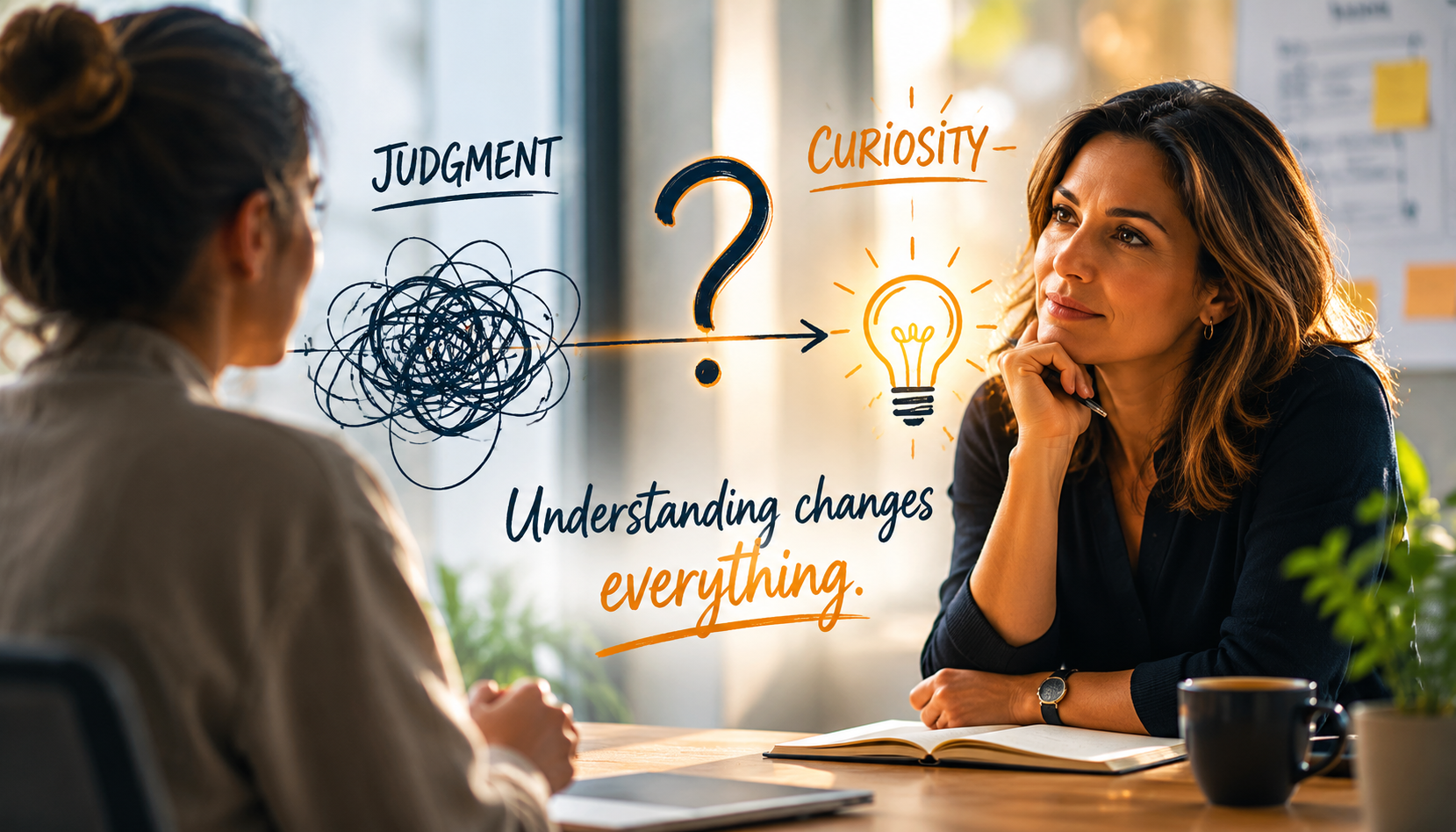
Curiosity Vs Judgement
The Most Underrated Leadership Skill Nobody Talks About
There's a question I come back to constantly in my work with leaders.
It's simple. It's uncomfortable. And in my experience, it changes things more reliably than almost any other single shift a leader can make.
What would I need to understand about this person to feel curious instead of frustrated?
I want to talk about why that question matters so much and why the default most leaders fall into, judgment, feels so reasonable even as it quietly undermines everything they're trying to build.
Why judgment feels like leadership
When a team member underperforms, a high-performing leader's instinct is usually swift and clear: this isn't good enough, and they need to hear that, or they should know that.
There's nothing wrong with that instinct at its root. Standards matter. Accountability matters. Leaders who never address poor performance do real harm to their teams and their cultures.
But there's a version of accountability that comes delivered as judgment - a verdict about the person's behavior, their attitude, their commitment - and a version that comes delivered as curiosity. And they produce very different outcomes.
Judgment says: I see what's happening, and it's not acceptable.
Curiosity says: I see what's happening, and I want to understand it.
The first closes a conversation before it's really started. The second opens it.
Here's what makes this so hard for strong leaders: judgment is faster. It feels decisive. It protects the standard visibly and publicly. In the short run, it can even look like leadership; clear, direct, unwilling to accept excuses.
But what happens next is rarely what the leader intended. The team member gets defensive. They start managing optics rather than improving performance. They tell the leader what they want to hear. They stop bringing problems forward because the risk feels too high. And the leader, watching this, often becomes more frustrated, because they were clear, and nothing changed.
What curiosity actually does
When a leader enters a difficult conversation carrying genuine curiosity, not as a technique, but as a real question about what the other person is experiencing, something different happens.
People feel it. Even when nothing is said explicitly, people have a finely tuned sense of whether they're being assessed or understood. When they feel understood, they open up. They share what's actually getting in their way. They stop performing and start being honest.
And honest conversations are the only ones where real change is possible.
This is not about softening expectations or lowering standards. A leader can hold a very high bar and still approach someone with curiosity. In fact, those two things together - high expectations held with genuine care - are the combination that tends to produce the most meaningful and lasting change.
What curiosity requires is a willingness to not already know the answer. To hold your interpretation loosely enough that new information can actually reach you. For leaders who have built their careers on clarity and conviction, that looseness can feel uncomfortably close to weakness.
It isn't. It's precision. You can't solve a problem you haven't actually diagnosed. Judgment skips the diagnosis. Curiosity insists on it.
The internal shift that makes this possible
I want to be honest: I believe it to be impossible to sustain genuine curiosity without doing some internal work first.
If you walk into a conversation already carrying a conclusion - this person is checked out, this person doesn't care, this person will never meet the bar - your curiosity will be performative at best. People will see through it quickly, and it will do more damage than honest frustration would.
The internal work is about getting curious with yourself before you get curious with them.
What am I assuming about this person's motivation?
Is there anything I haven't communicated clearly that might be contributing to this gap?
What do I actually know versus what am I inferring?
Have I created the conditions for this person to succeed?
These questions are uncomfortable because they don't let you stay purely on the outside of the problem. They ask you to look inward, which is not the reflex of most high-performing leaders and it requires effort and personal investment.
But they're also the questions that begin to shift a leader's impact from episodic to sustained. From managing performance to actually developing it.
A pattern I've watched unfold
I work with leaders who arrive in our conversations genuinely frustrated. They've had the same disappointing exchange with the same team member multiple times. They've expressed their expectations clearly. They cannot understand why nothing is changing.
We work through it together, not the other person's behavior, but the leader's approach. What they've actually communicated versus what they intended. How the conversation was opened. What room was left for the other person to be honest rather than just absorb feedback.
And incrementally, slowly, imperfectly, with plenty of steps backward before steps forward, they begin to try something different. A question instead of a verdict. A pause before a conclusion. An acknowledgment before a challenge.
The results are never immediate. But they are consistent. People begin to respond differently when they sense that the leader in front of them is genuinely interested in what they're experiencing, not just in whether they're meeting the bar.
One question to carry with you
If there's a person on your team right now that you're frustrated with, I'd invite you to sit with this before your next conversation:
What would I need to understand about their experience to feel genuinely curious rather than frustrated?
You don't have to have the answer. The question itself is enough to start with.
Curiosity isn't the absence of standards. It isn't the suspension of accountability. It's the thing that makes both of those actually work.
And in my experience, it might be the most underrated tool any leader has.
Melinda East is a certified executive coach and people strategy partner working with leaders navigating significant transitions. She helps leaders build the emotional intelligence and influence required to lead with both clarity and humanity.
